Saturday, January 29, 2011

IAr221- Blog Post #3 Taking a look at UNCG through ten idea principles

For this weeks blog post we are to take the ten idea principles discussed in class with the Acropolis and Xianyang Palace and apply them to our campus here at UNCG. Here is what I HYPOTHESIZE:

1. Space

In thinking about the space of UNCG, the following words come to mind: enclosed, honored, and reserved. If you take a look at the campus entrances here at UNCG, one would get a since that the campus is enclosed and has a barrier surrounding it. What makes one fill this way is the implied barrier the campus has through the brick walls on either side of the four entrances. This space is reserved for those who have come here to learn and receive higher education. Though one can drive through campus, this barrier shows that reverence for the ones who are actually attending the university. The space of this campus is also honored by the surrounding area as well as people because of its history and purpose. The space also honors all the alumni, the Womens College of North Carolina as well as the founder, Charles Duncan McIver.


2. Power

When thinking about power associated with the university, I hypothesize that power is having a better education. If one thinks about it, someone who applies for a job with a college degree against someone who does not, will more than likely receive the job. It is similar to the hierarchy of the Egyptian pyramids; the higher your education, the higher your ranking and your pay will be. Therefore, the people who attend college at this campus will more than likely be recieving a higher power than someone who does not. That does not mean to not consider other universities because they too help people receive these "powers". But, in looking at statistics and ratings, UNCG is said to be a "Best Value college", as well as one of the most diverse campus' around.

Power of UNCG is also represented in the statues of Minerva and Charles McIver. Minerva represents power in wisdom, intellegence, learning, and discipline of war. Charles McIver represents power in founding the campus as well as knowledge.


3. Experience

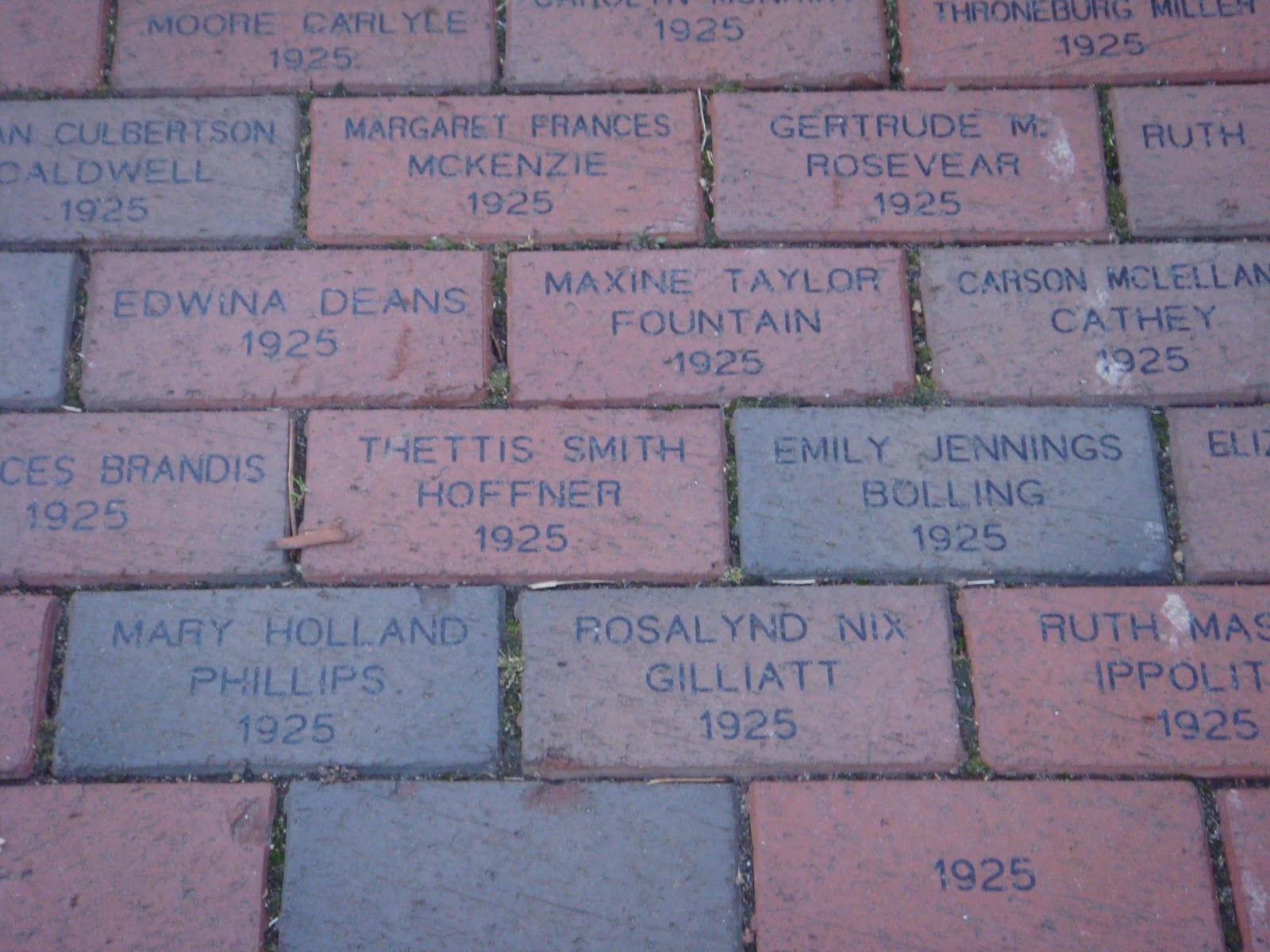
There is a ton to relate to experience here at UNCG. When first looking at experience represented here at the university I think of dorm life and being away from home. This campus represents a new start and a new beginning and faze of your life. Ones experience here will be with them forever. This is evident in the Alumni house. Due to peoples experiences here when they attended, they would like to still contribute and give back to the university as well as be a part of it. This campus is something that will give us experiences that will be with us forever. Another example of experience on campus is the graduate sidewalk through the park. It is here that we as students and faculty can walk over and see the names of those impacted through experience here at uncg through there completion of studies and graduation from the university. By walking this sidewalk and seeing the names, we are gaining an experience ourselves before we come to that part of our journey.


4. Principles

When thinking about principles I think of beliefs and purpose of the campus. Some of these are "School comes first" and "A student should devote so many hours to their studies a week". These beliefs are some of the principles here on campus and this is evident in all the areas devoted to student learning, especially the library, the campus meals to go, and the writing center.

5. Precedent

In thinking of precedents in relation to campus I think of campus protection and location. UNCG is located in the city which has a lot around it, however based off the layout and ways of protection, one can feel safe here on campus. This is shown through the campus' overall design.


6. Site

The site of campus is in Greensboro, NC. It is located close to the downtown area, but is not in downtown, making it convenient yet home like. The campus takes pride in its site in showing Greensboro in the name of the school as well as on the signs around campus. Pictures inside some of the buildings also show this dedication and pride in its site.


7. Order

Order of the UNCG campus is to help harmonize the area and yet make it serious. That is when looking at the campus layout, buildings, etc. This is also seen in the ranking of student classification; seniors have a higher classification than freshmen. Order of the campus also often suggests that one, "complete this to do that" approach. An example of this approach in order is having prerequisites for classes. A way this campus has used order is by making each specific school have its own unique building, especially designed for them. We see this in the School of Education building and the Stone Building (HES).


8. Scale

UNCG has a wide scale in my mind. Scaling of building and the school has changed over the years. It started off as one building and now has well over 50 on 210 acres. Not only is the scale of the buildings changed, but also in what the school offers in learning. UNCG now offers over 100 undergraduate degrees, 61 masters, and 26 doctorate degrees. Students also come from farther away than ever before. UNCG has a diverse population of students coming from 46 states and 90 countries. This campus has went out of the actual land scale to a global scale, making their name known to the world.

9. Technology

Technology on the UNCG campus is everywhere. It is in students pockets, backpacks, in the food court, computer labs, the library, the lighting in and out of buildings as well in the architecture surrounding the school. In taking a look at the first building built on campus to the newest one being built today, one can see that technology has risen to new and greater heights. Newer buildings on campus now offer more steel beams and glass windows, which brings us to the next idea of surface.


10. Surface


In looking at the surfaces of the buildings on campus, one can see the changes of time. The oldest builing (Foust 1891) is made of brick, has old pane windows, and a more gothic style approach to it. The newest builings being built today (The new Education Building and new dormitory) show steel beams, glass windows, and a more modern style. Surface of the campus will and has continued to change over the years.


Sunday, January 23, 2011

Light Box- Defining 4 spaces of light

For our first project in Studio this semester, we were to create a box with dimensions : 12x12x18 with one of the 12x12 sides left open. We were then instructed to make slits in the box and try to divide the box into four distinct places/spaces of light. My idea and execution for this project was to make the box have the most minimal slits possible. I made a small scale model which had removal tops so I could try out several ideas. In my final idea I have one slit at the top at an angle. This slit is a triangle shape. To make four distinct spaces I chose to use two light sources. One light source (my desk lamp) is places laying parallel to my box on the same table. This light is warm so it makes an orange tint inside the box. The other light is a cool light source and is positioned right above the crack at the top of my box. The two structures (bristol board) inside the box are used to divide the light sources as well as let the light spaces stand out. A scale figure was also added for the viewer to get an idea as to what scale this building would be in.


Scale model used in processing ideas and thoughts

Scale model tops of the box with measurements


scale figure and view of inside the right section of the final box

light box in day light and with natural light going in it

light box with light sources on it. The four sections of light are visible

picture 2 of inside light box
picture 3


IAR221- Blog post #2 Humanity's first efforts to place buildings on the landscape using: circles, groups, stacks, people

In trying to understand humanity's first efforts to place buildings on the landscape, I look at the campus here at UNCG. Even today, one can see the use of circles, groups, and stacks when looking at architecture.

Circles: the Sun + the Moon + sacred spots

Looking up when walking in the back of the EUC

On the floor at the back of the EUC

The Front entrance of the EUC looking up

The floor of the front entrance of the EUC

The wall of the front of the EUC. This shows the curve in the wall and groups of panels on wall.


In looking at the EUC entrances in both the front and the back, there are circles. These circles are physically shown on the floor as well as implied through it rising up to the top floor and into the ceiling. The meaning of circles often mean unity, importance, a sacred space. I can see these meanings at these locations. These entrances into the EUC are important because it is where college students come and gather. It is a sacred spot because it is a building dedicated to students and their needs. These locations are also places in which students will pass when on their way to classes.


This drawing of the clock tower shows the use of circles as unity and importance. The circle of the clock shows time is never ending and that the time of day always repeats itself. This clock tower symbolizes time spent here on campus. The circles walk around it is so that students can walk around it because it is said that if one walks under it then they will not graduate on time. The top of this tower shows stacks and the columns holding up the clock tower shows groups, order, and placement.

Here is some more examples of circles seen on campus.


Groups: groves of trees, reaching vertical, groups of people.


The columns in the EUC on either side of the hall make groups. These circular columns also imply the unity and sacred aspect of circles. These columns reminded me of the example of the elegant porch shown in class.

Another example of a group is the group of trees in the walk heading towards the Sullivan Science Center. This is actually a grove of trees. In looking closer at the trees, one can see that the placement of the trees was planed and thought out. The dimensions of the square under each tree is perhaps a fourth of the square between the other trees.


Stacks: mountains, gathering resources


As you see this building is a stack of different levels on top of each other. The importance of the levels  with the ones on top having more importance. This is similar to the pyramids and ziggurats. They make the levels of this building known by having some levels protrude and break away from the others.


The top of the education building is just one of the many examples of stacks seen on campus. This is perhaps a symbol of the hierarchy of the education systems and the different levels of knowledge.

There can also be combinations of circles, groups, and stacks within one building or form. The Sullivan Science Center is an example of this.


As you see, the circle towers on top  are circles and groups. The stacking of levels and the roof show the element of stacking.

In looking at all three forms of elements on campus, the question often thought is do environments influence rituals or do rituals influence environments? I believe that both the environment and rituals affect each other.

Environments affect rituals in that on campus, the 'rituals' of honoring minerva or the colors blue & gold make since on the uncg campus. However, on or in another environment such as your home, Minerva and the colors blue & gold would not be seen as important or a ritual.

Rituals affecting environments can be seen on campus too. The 'ritual' of devotion and time devoted to studying as a means to improve our life. Because of this 'ritual' the environment of the school is developed to help show and support this. It will help one achieve and perform this 'ritual' of making their life better through learning. A way to make the environment form to the rituals is by building structures that promote learning, centers to work on studies (library), and dormitory's so people can live close to where they are to achieve these rituals (studies).

So, as you can see in looking at the UNCG campus, one can see the continual use of circles, groups, and stacks as well as the ways in which both rituals and environments affect each other.

Saturday, January 22, 2011

The Start to A Hundred Chairs

For History and Theory of design 1, I am creating a series of 100 chair cards. The chair cards consists of information on one side and a drawing of the chair on the opposite. The information includes the chair name, the designer, manufacturer, dimensions, and source for the picture. In the picture below you will see the first ten chair cards I have produced. Most of these cards are from ancient times; they are in fact the start of chair history.


Tuesday, January 18, 2011

Reading Response #2 for History and Theory of Design

Sources:  Global History of Architecture Ching,  Understanding Architecture Roth, military website


For my first reading response, my group was given the topic of Mesopotamian Cities: Eridu and Uruk. I chose to do a hand draft to present my information and the topic.

Monday, January 17, 2011

New Header for the New Semester

For my first drafting assignment for the semester, I was asked to create a new header for my desk and blog that showed who I am as a designer. In just starting to figure out exactly who I am as a designer, lots of thoughts flooded my mind. When I think of the aspects and qualities that make me the designer I am as well as inspire me to design the things I do, here is what came to mind: structure, form, unity, uniqueness, creativity, new, interest, travel, roundness,  my "stamp"/fingerprint on life. My design is what I leave behind for others to use, enjoy, and have to strengthen and improve their way of life. In thinking about design, I become inspired by things I see when I travel. When traveling, I am able to see various forms of design in different cultures. Through this exploration of travel I am able to take the multiple designs and creations from others and combine them in my head to create something of my own. When visually designing in my head (based off the things I see when traveling) I tend to focus on structure and form of the objects I see. I also want structure and form to be in what it is that I design. I also want unity in my designs. I tend to make my work be unique, out of the ordinary, and unified.

For this designed header I chose to design it showing these things. In thinking about travel, structure, form, and unity, while keeping my creative spirit alive, I chose to design a traveling header. As a symbol of my use of structure I chose to incorporate the Eiffel Tower. For my "stamp" on life as well as wanting my design to be one that various cultures and parts of the world can use and enjoy I incorporated stamps on the right. I placed them on the right so that it is like a lettered stamp you mail (it moves to new locations). The uniquely designed circles in the background are to represent unity and creativity. Lastly, the round postal stamp is used as a location for my class information because a round postal stamp is something that tells the viewer of the mail slip something that is important; to me this class is important and is the purpose of this header as well as where I am now in my design traveling experience. I hope that you are able to see that this header is me as a designer.